

Close Menu
    Facebook X (Twitter) Instagram
    Cloud Tech ReportCloud Tech Report
    • Home
    • Crypto News
      • Bitcoin
      • Ethereum
      • Altcoins
      • Blockchain
      • DeFi
    • AI News
    • Stock News
    • Learn
      • AI for Beginners
      • AI Tips
      • Make Money with AI
    • Reviews
    • Tools
      • Best AI Tools
      • Crypto Market Cap List
      • Stock Market Overview
      • Market Heatmap
    • Contact
    Cloud Tech ReportCloud Tech Report
    Home»Crypto News»Blockchain»Polygon Reduces Block Production Time to 1.75 Seconds
    Blockchain

    Polygon Reduces Block Production Time to 1.75 Seconds

    May 7, 2026
    Facebook Twitter Pinterest Telegram LinkedIn Tumblr WhatsApp Email
    Cointelegraph
    Share
    Facebook Twitter LinkedIn Pinterest Telegram Email
    kraken


    Blockchain layer-2 (L2) network Polygon reduced its average block time by 250 milliseconds to 1.75 seconds, marking its first block-time reduction since genesis as the network pushes deeper into stablecoin payments and settlement infrastructure.

    Polygonscan shows that the latest blocks on the network were created in 1.75 seconds. The upgrade means that Polygon can process around 14% more payments per second, reaching a maximum theoretical throughput of about 3,260 transactions per second (TPS), according to Polygon software engineer Lucca Martins.

    Shorter block times can help transaction backlogs clear faster, reducing the duration of network congestion and subsequent transaction fee spikes, which is particularly important for high-frequency use cases such as payments, stablecoins or decentralized finance (DeFi) trading.

    The upgrade comes as Polygon makes efforts to position itself for use cases targeting more institutional adoption, such as private stablecoin payments. On Tuesday, Polygon introduced a new wallet feature that enables users to privately route stablecoin transactions through a shielded pool verified by zero-knowledge proofs.

    binance

    The upgrade is part of the Polygon Improvement Proposal PIP-86, a two-step motion that seeks to further reduce block time to 1.5 seconds and scale down checkpoint rewards to maintain the Polygon (POL) token emissions at the target 1% after the block time reduction. 

    Polygon blockchain explore, latest blocks, production time. Source: Polygonscan

    Cointelegraph reached out to Polygon for comment on its block time reduction plans, but had not received a response by publication.

    Related: Morgan Stanley takes on crypto trading rivals with E*Trade pilot

    Polygon targets private stablecoin payments to onboard institutions

    Polygon’s new wallet feature is part of an aim to onboard more institutional users as it hides senders, receivers and amounts onchain while maintaining compliance through Know Your Transaction (KYT) screening and auditable files.

    The feature introduces more privacy for businesses transacting with stablecoins, according to Polygon community lead Smokey. 

    Despite the upgrade, Polygon’s (POL) token remained stagnant over the past 24 hours and traded at $0.09 at the time of writing. The token is down 54% over the past year, CoinMarketCap data shows.
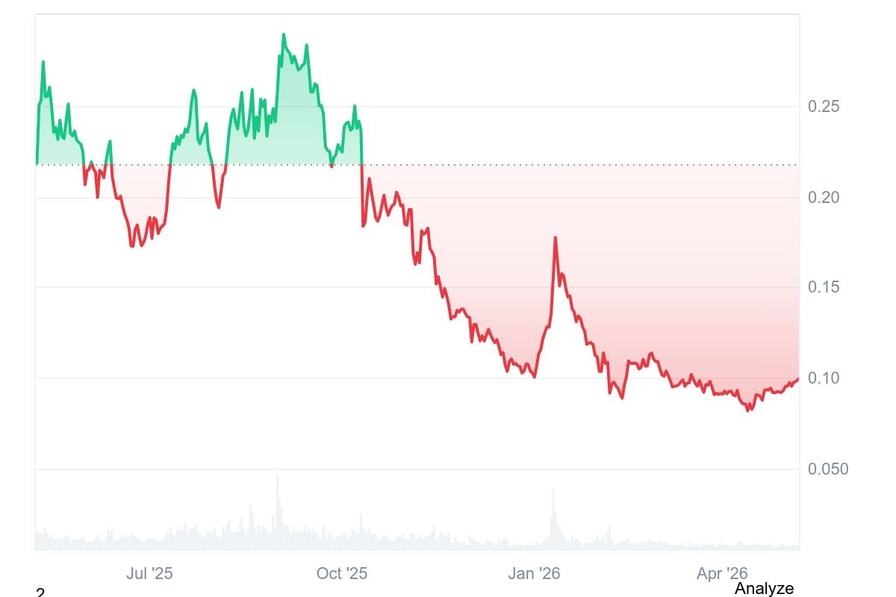
    POL/USD, one-year chart. Source: CoinMarketCap

    Polygon has also integrated with large credit card providers. On April 29, global payments giant Visa expanded its stablecoin pilot to include support for Polygon Base, the Canton Network, Arc and Tempo.

    Launched by Visa in 2023, the pilot allows partners to settle transactions through stablecoins rather than traditional banking rails, to evaluate whether stablecoins can offer faster settlement.

    Magazine: Will the CLARITY Act be good — or bad — for DeFi?

    Cointelegraph is committed to independent, transparent journalism. This news article is produced in accordance with Cointelegraph’s Editorial Policy and aims to provide accurate and timely information. Readers are encouraged to verify information independently.


    Source link

    livechat
    Share. Facebook Twitter Pinterest LinkedIn Tumblr Email

    Related Posts

    NVIDIA Nemotron 3 Ultra Sets New Standard for RTL AI Efficiency

    July 27, 2026

    Frax Proposal Would Allow Early frxETH Redemptions With 4% Penalty

    July 26, 2026

    Strategy now publishes the Bitcoin return threshold below which it may have to restructure

    July 25, 2026

    Kakao, Circle Explore Won Stablecoin Payment Infrastructure

    July 24, 2026

    Institutional Ethereum Stakers Weigh Speed and Privacy Trade-off Under EIP-8222

    July 23, 2026

    Polymarket odds for Hormuz normal traffic drop to 54% after Iran strike reports

    July 22, 2026
    kraken
    Latest Posts

    5 Stocks I’m Buying HEAVY Right Now August 2026

    July 27, 2026

    VentureBeat Research: Where enterprise AI agent governance hasn't caught up

    July 27, 2026

    The ONLY Way To Make Money With AI Digital Products In 2026 (Copy Me)

    July 27, 2026

    Here’s What Tesla Did With Its Bitcoin Holdings in Q2 2026

    July 27, 2026

    The basics of AI image prompting

    July 26, 2026
    quillbot
    LEGAL INFORMATION
    • Privacy Policy
    • Terms Of Service
    • Social Media Disclaimer
    • DMCA Compliance
    • Anti-Spam Policy
    Top Insights

    Strategy Adds $525M to USD Reserve, Pushing Dividend Coverage to 2.1 Years

    July 27, 2026

    Can Bulls Repair the Damage?

    July 27, 2026
    synthesia
    Facebook X (Twitter) Instagram Pinterest
    © 2026 CloudTechReport.com - All rights reserved.

    Type above and press Enter to search. Press Esc to cancel.

    bitcoin
    Bitcoin (BTC) $ 64,890.00
    ethereum
    Ethereum (ETH) $ 1,943.33
    tether
    Tether (USDT) $ 0.999135
    bnb
    BNB (BNB) $ 574.05
    usd-coin
    USDC (USDC) $ 0.999642
    xrp
    XRP (XRP) $ 1.09
    solana
    Solana (SOL) $ 75.81
    tron
    TRON (TRX) $ 0.327598
    figure-heloc
    Figure Heloc (FIGR_HELOC) $ 1.03
    staked-ether
    Lido Staked Ether (STETH) $ 2,265.05