

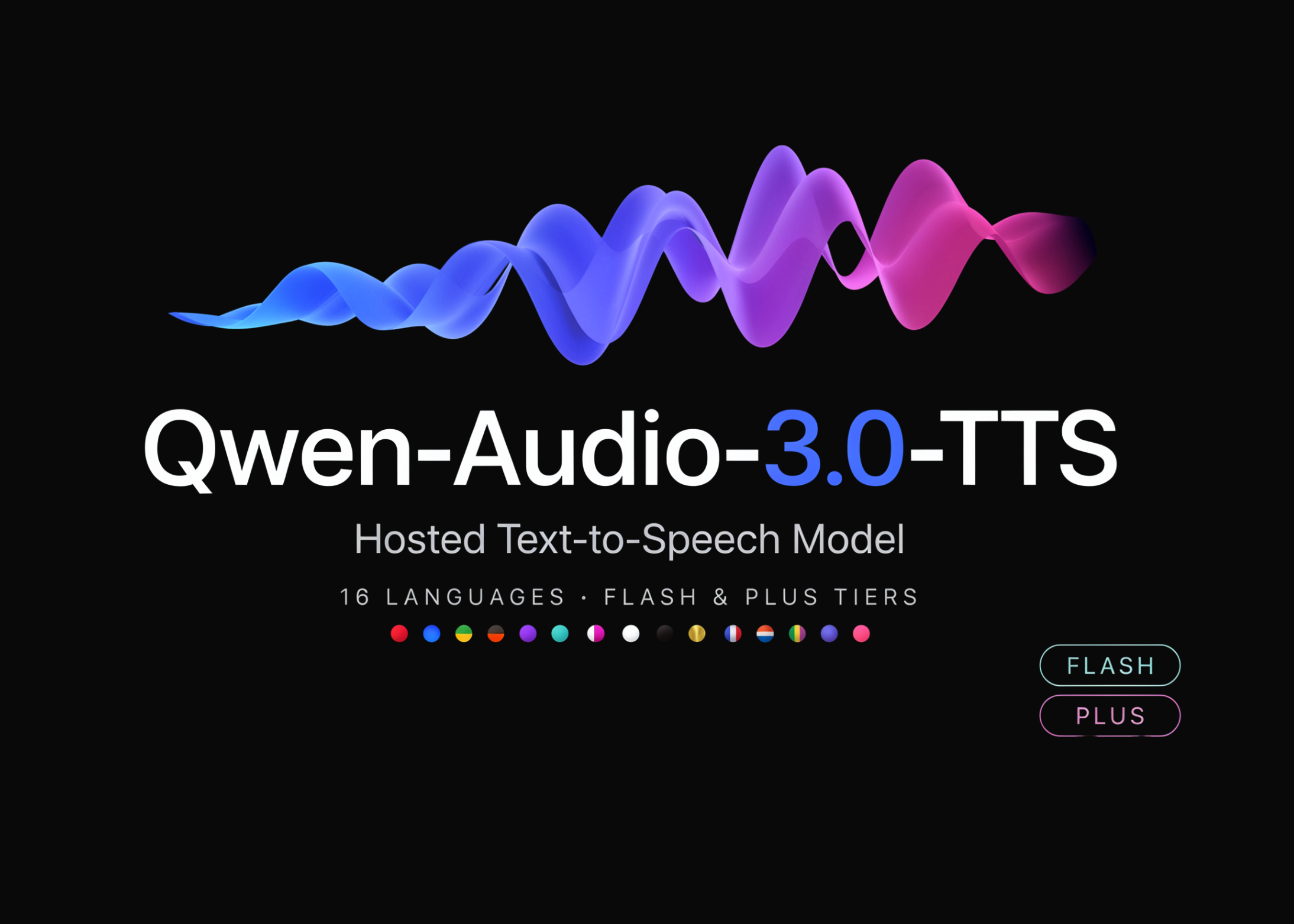

Alibaba’s Tongyi Lab has released Qwen-Audio-3.0-TTS, a production-oriented text-to-speech (TTS) system. The model ships in two variants from the same lineage. Flash targets real-time interaction. Plus targets high-quality generation. Both are delivered as hosted models through Alibaba Cloud Model Studio, not as downloadable weights.
The release focuses on four things developers hit in production: broader language coverage, natural-language style control, fine-grained tag control, and robustness when the reference audio is not clean. Qwen-Audio-3.0-TTS-Plus also ranks first on the independent Artificial Analysis Text-to-Speech leaderboard.
Two variants, one lineage
The two tiers map to different jobs. Flash is tuned for real-time interaction, with first-packet latency at the 300 ms level. Plus is tuned for high-quality generation, where naturalness and timbre fidelity matter more than speed.
The model IDs are qwen-audio-3.0-tts-flash and qwen-audio-3.0-tts-plus. Both are called over a bidirectional WebSocket streaming protocol. The API supports PCM, WAV, MP3, and Opus, with sample-rate output up to 48 kHz. It exposes streaming input and output, voice cloning, Voice Design, and instruction control. Alibaba provides the DashScope SDK plus raw WebSocket examples in Python, Java, Go, C#, PHP, and Node.js, across its Singapore and Beijing regions.

How the model is built
Two design choices anchor the system.
The model also handles one-pass long-form synthesis up to 3 minutes, hard text-normalization cases, and vocoder super-resolution for 48 kHz output.
Multilingual coverage across 16 languages
Qwen-Audio-3.0-TTS supports 16 languages: Arabic, Chinese, English, French, German, Indonesian, Italian, Japanese, Korean, Malay, Portuguese, Russian, Spanish, Tagalog, Thai, and Vietnamese. Seven of these are newly added versus the prior line. It also covers 20 Chinese dialect regions.
On multilingual intelligibility, the model family posts the best word/character error rate (WER/CER) in 10 of the 16 languages. Flash delivers the lowest average WER/CER at 3.87; Plus is close at 3.96. Lower is better on this metric.
On speaker similarity, Plus ranks first across all 16 languages with an average of 82.75, and Flash follows at 80.44. The release also adds a curated preset voice library spanning the 16 supported languages, so teams can ship a voice without cloning one first.
For precise control, the research team embed inline tags directly in the target text. The release adds 86 fine-grained inline tags for localized control at the phrase and word level. These cover expressive transitions and non-verbal events such as laughter, breathing, coughing, and sighing.
The Model Studio documentation splits these into two groups. Control tags such as [excited], [sad], [whispers], and [asmr] set an emotion or style until the next tag. Rich-language tags such as [laughing], [gasp], and [clears throat] insert a single vocal effect without changing surrounding tone. A worked example: [excited]What a beautiful day today![laughing]Let’s go out and have fun together! One limitation is worth noting here: these emotion and rich-language tags are supported only in unidirectional streaming mode.
Where it stands on the leaderboard
Qwen-Audio-3.0-TTS-Plus took the top quality spot on the Artificial Analysis Speech Arena for Provider Voices. It posts an Elo near 1,236, narrowly ahead of Simba 3.2 at 1,234, and clear of Gemini 3.1 Flash TTS (1,214) and Sonic 3.5 (1,207). The lead over Simba 3.2 sits inside overlapping confidence intervals, so it is a statistical tie at the very top.
Two trade-offs are worth stating plainly. Throughput is modest: Plus generates about 16 characters per second, below Simba 3.2 (30.2), Gemini 3.1 Flash TTS (27), and Sonic 3.5 (120). Price is competitive: the listed rate is $27.59 per 1M characters, roughly a third of what ElevenLabs and MiniMax charge for the tiers it outranks. Rank and price move often, so confirm both before planning around them.
How developers and the community are reacting
The early reception is cautiously enthusiastic. The most-shared story is that a non-Western TTS topped the arena at a fraction of incumbent pricing. The most common reservations are that the model is hosted-only, that its throughput trails rivals, and that its name overlaps with the open Qwen3-TTS line. The dashboard below aggregates that early signal across X, Reddit, and Hacker News.
Key Takeaways
- Qwen-Audio-3.0-TTS is a hosted TTS model in two tiers: Flash (~300 ms first-packet, real-time) and Plus (quality-first).
- Plus ranks #1 on the Artificial Analysis arena at ~1,236 Elo, priced at ~$27.59 per 1M characters, but only ~16 chars/sec throughput.
- Coverage spans 16 languages and 20 Chinese dialects, with best WER/CER in 10 of 16 languages and top speaker similarity on Plus.
- Control comes two ways: free-style natural-language instructions and 86 fine-grained inline tags for non-verbal detail.
- It is distinct from the open-weight Qwen3-TTS (Apache-2.0) line; the 3.0 model is API-only via Alibaba Cloud Model Studio.
Sources: Qwen-Audio-3.0-TTS release blog · Tongyi Lab announcement · Alibaba Cloud Model Studio real-time TTS docs · Artificial Analysis leaderboard · Tongyi Lab on X
Asif Razzaq is the CEO of Marktechpost Media Inc.. As a visionary entrepreneur and engineer, Asif is committed to harnessing the potential of Artificial Intelligence for social good. His most recent endeavor is the launch of an Artificial Intelligence Media Platform, Marktechpost, which stands out for its in-depth coverage of machine learning and deep learning news that is both technically sound and easily understandable by a wide audience. The platform boasts of over 2 million monthly views, illustrating its popularity among audiences.