

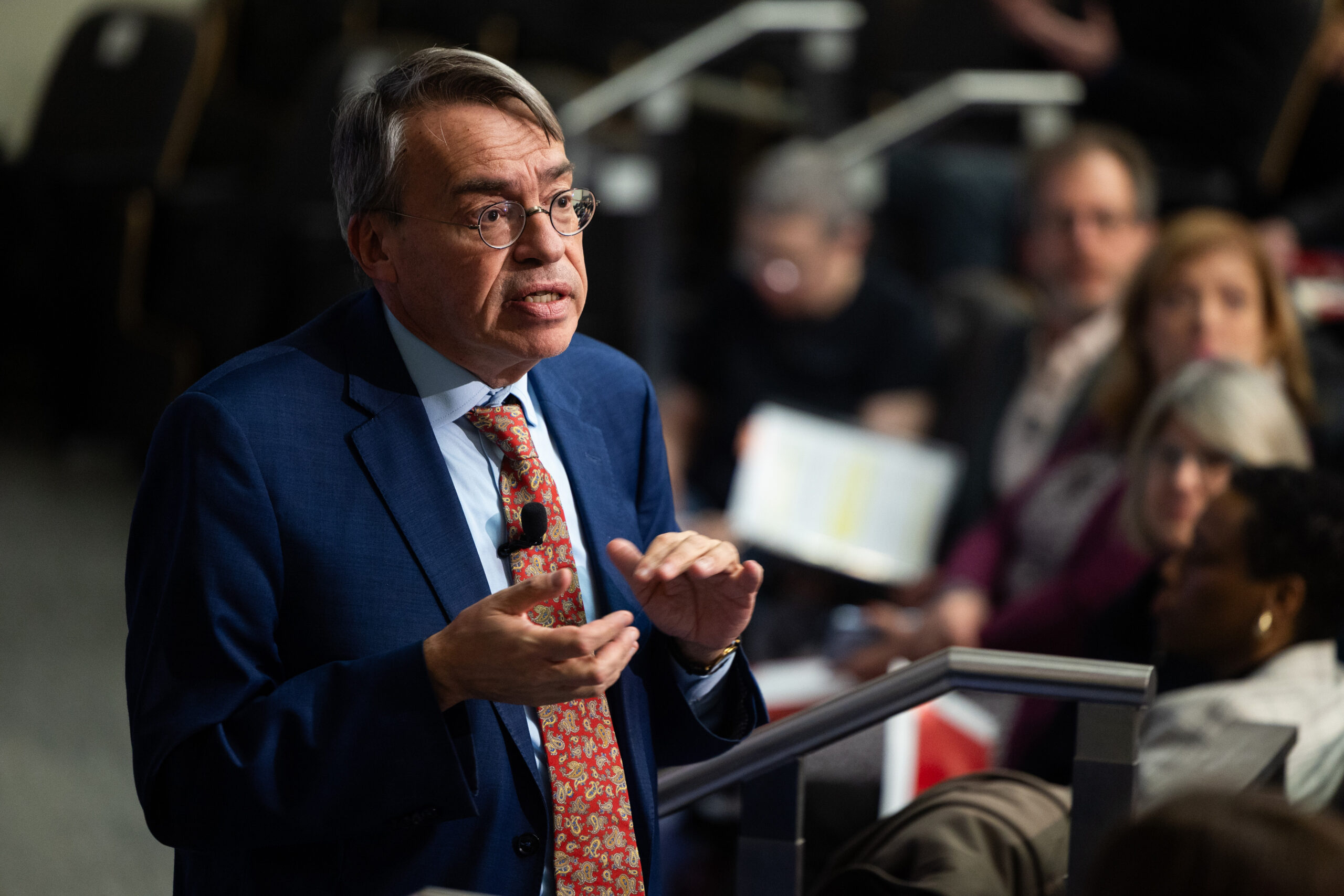

From enhancing international business logistics to freeing up more hospital beds to helping farmers, MIT Professor Dimitris Bertsimas SM ’87, PhD ’88 summarized how his work in operations research has helped drive real-world improvements, while delivering the 54th annual James R. Killian Faculty Achievement Award Lecture at MIT on Thursday, March 19.
Bertsimas also described how artificial intelligence is now being used in some of his scholarly projects and as a tool in MIT Open Learning efforts, which he currently directs — another facet of a highly productive and lauded career over four decades at the Institute. The Killian Award is the highest prize MIT gives its faculty.
“I have tried to improve the human condition,” Bertsimas said, summarizing the breadth of his work and the many applications to everyday living that he has found for it.
At MIT, Bertsimas is the vice provost for open learning, associate dean for online education and artificial intelligence, Boeing Leaders for Global Operations Professor of Management, and professor of operations research in the MIT Sloan School of Management. He also served as the inaugural faculty director of the master of business analytics program at MIT Sloan, and has held the position of associate dean of business analytics.

Bertsimas’ remarks encompassed both his past insights and his ongoing studies, as well as his current efforts to add AI to his research. Describing the concept of “robust optimization,” a highly influential approach that Bertsimas helped develop in the early 2000s, he explained how it has enabled, for instance, more reliable shipping through the Panama Canal. Other approaches to optimization aimed at getting more vessels through the canal every day — up to 48 — but would encounter significant problems at times. Bertsimas’ approach identified that 45 vessels a day was better — a slightly lower number, but one that “was always feasible,” he noted.
Over time, Bertsimas’ work has helped structure all kinds of solutions in business logistics; it has even been used for the allocation of school buses in Boston.
More recently, as Bertsimas explained in the lecture, he and his collaborators have been working with Hartford HealthCare in Connecticut on a wide range of issues, and are increasingly incorporating AI into the development of tools for diagnostics, among other things. On the optimization front, their research has suggested ways to reduce the average stay of a hospital patient, from 5.38 days to 4.93 days. In the main Hartford hospital they have studied, given the number of existing beds, that reduction has enabled more than 5,000 additional patient stays per year.
“It’s a very different ballgame,” Bertsimas said.
Bertsimas delivered his lecture, titled “Algorithms for Life: AI and Operations Research Transforming Healthcare, Education, and Agriculture,” to an audience of over 300 MIT community members in Huntington Hall (Room 10-250) on campus.
The award was established in 1971 to honor James Killian, whose distinguished career included serving as MIT’s 10th president, from 1948 to 1959, and subsequently as chair of the MIT Corporation, from 1959 to 1971.
“Professor Bertsimas’ scholarly contributions are both extensive and groundbreaking,” said Roger Levy, chair of the MIT faculty and a professor in the Department of Brain and Cognitive Sciences, while making introductory remarks. “He’s one of the rare individuals who has made significant contributions to both intellectual threads in the field of operations research: one, optimization — combinatorial, linear, and nonlinear — and number two, stochastic processes.”
Indeed, Bertsimas’ work has helped develop both better tools for studying and conducting operations, while also having a wide range of applications. As Bertsimas noted in his lecture, the deaths of both of his parents in 2009 helped propel him to start looking at extensively at ways operations research could help health care.
Bertsimas received his BS in electrical engineering and computer science from the National Technical University of Athens in Greece. Moving to MIT for his graduate work, he then earned his MS in operations research and his PhD in applied mathematics and operations research. Bertsimas joined the MIT faculty after receiving his doctorate, and has remained at the Institute ever since.
Bertsimas is also known as an energetic teacher who has been the principal advisor to a remarkable number of PhD students — 106 and counting, at this point.
“It is far and away my favorite activity, to supervise my doctoral students,” Bertsimas said. “It is a privilege, in my opinion, to work with exceptional young people like the ones we have at MIT, in ability and character and aspiration. They actually make me a better scientist, and a better person.”
“MIT is part of my identity,” Bertsimas quipped while noting that he is the only faculty member on campus who has those three letters, in order, in his first name.
In the latter part of the lecture, Bertsimas highlighted work he has been doing as vice provost of open learning at MIT. He has personally developed an large online course based on his own material, “The Analytics Edge.” In his current role, Bertsimas said, he now aspires for MIT to reach a billion learners with online courses, part of his effort to “democratize access to education.”
Bertsimas also demonstrated for the audience some AI tools he and his colleagues are working to bring to online education, including ways of condensing material, and the translation of online material into other languages.
It is just one more chapter in a long and broad-ranging career dedicated to grasping phenomena and developing tools to help us navigate it.
Or as Berstimas noted while summarizing his scholarship at one point in the lecture, “I try to increase the human understanding of how the world works.”