

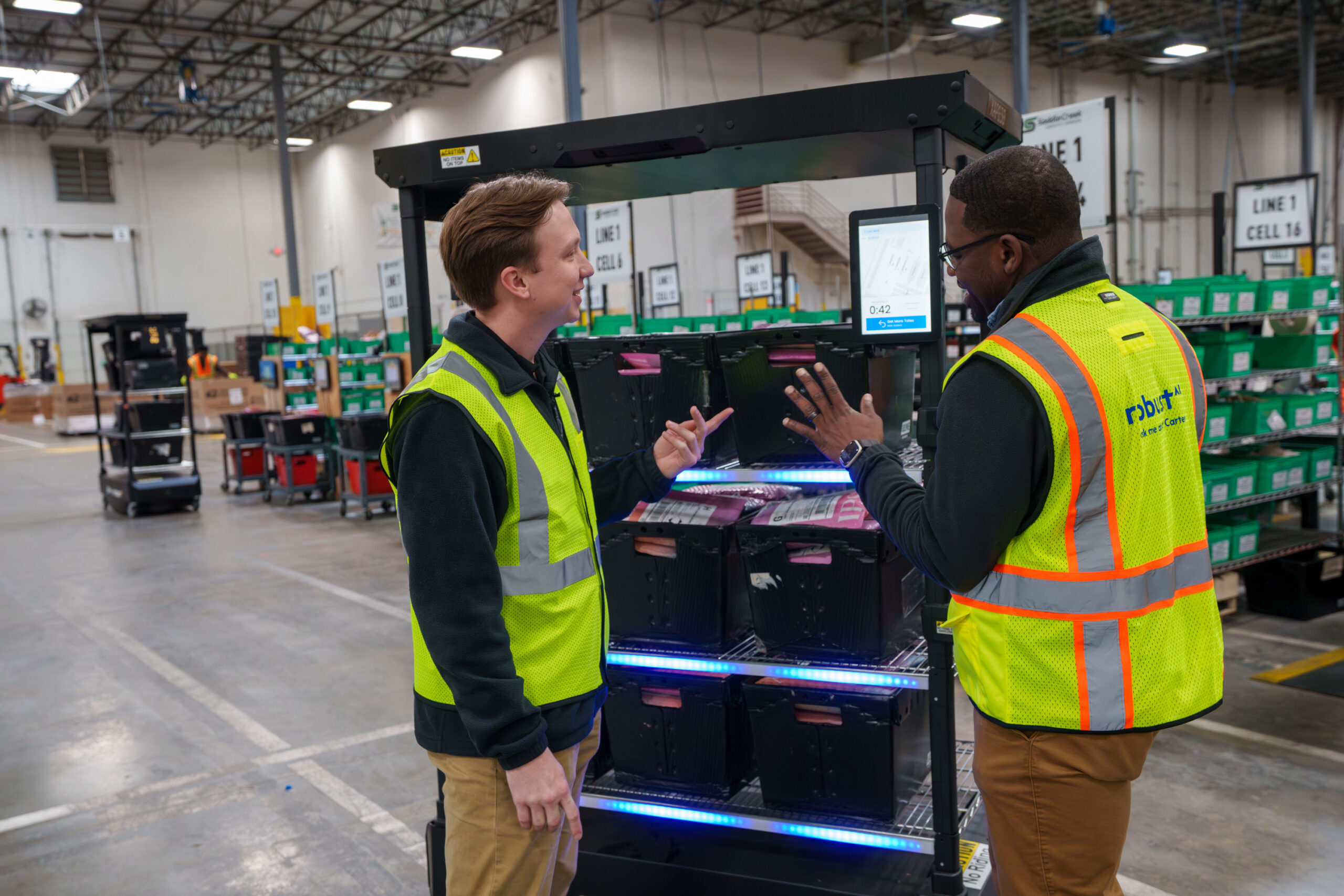

“In these environments, what really determines success is how the overall system performs,” explains Anthony Jules ’92, SM ’92, who co-founded the company with MIT Professor Emeritus Rodney Brooks. “The robot does some of the work, the people do some of the work, and the backend systems do some of the work. It’s that combination that determines how well your system performs. We believe it’s really important that people have an appropriate level of agency and input so that they’re always moving the system forward.”
Collaborative robots
Brooks was a faculty member at MIT from 1984 until 2010 and served as the director of the Computer Science and Artificial Intelligence Laboratory (CSAIL) from 1997 until 2007. While at MIT, he co-founded iRobot, which invented the popular Roomba vacuum and went public in 2005. Later, he co-founded the company Rethink Robotics, which also designed collaborative robots.
Jules met Brooks as a graduate student at CSAIL in the 1990s. The two never worked together, but their labs were on the same floor. The pair kept in touch after Jules graduated and co-founded the company Sapient, which went public before being acquired by Publicis in 2015.
In 2019, Brooks bumped into Jules at a robotics conference. He told Jules he was thinking of starting a robotics software company, which he compared to a video game engine for training robots. Robust AI was founded later that year.
The Covid-19 pandemic caused the founders to shift to creating robots that could autonomously disinfect surfaces, but when it was discovered that Covid-19 was not transmitted via surfaces, they had to pivot again.
“That forced us to decide how to use this technology we had been building, which was really about helping robots understand the world more fully,” Jules recalls. “Long story short, I said to Rodney, ‘I have an idea. You’re going to love it and you’re going to hate it. You’re going to love it because it’s solving problems for customers that we’ve been hearing about, and you’re going to hate it because we have to build hardware.”
The founders had been interviewing potential customers for years through Robust AI’s early pivots. They finally decided on logistics and manufacturing as the industries to target early on.
“When people think about automation in factories, they think about pictures of the 5 percent that are fully automated with $50 to $200 million dollar systems,” says Jules, who now serves as Robust AI’s chief innovation officer. “They don’t think about the vast majority of factories that aren’t automated at all. These factories don’t even have a conveyor belt. They are not going to tear everything out and replace it with a $200 million system.”
Robust AI’s robots can be phased into operations as needed and offer several workflows for customers. In one workflow, the robot can guide human workers to specific spaces to retrieve items. In another it can follow humans to important spots for loading. The primary workflows involve Carter robots moving things from one place to another, often in large warehouses or factories, where they say human workers can walk on average 30,000 steps a day.
“These are huge spaces, so a person might load the robot with things and then need to bring them to another station, but that could be 400 feet away,” says, Brooks, Robust AI’s chief technology officer. “Now the person can just say ‘done’ and the robot brings it instead. How the robots are integrated into the workspace is entirely up to the customer.”
Getting work done
Leila Takayama, Robust AI’s vice president of human robot interaction, recently discovered a peer-reviewed study of robots in hospitals, which were used to do things like gather dishes, move sheets, and transport other equipment. The researchers discovered that, in many hospitals, a large number of robots were turned off and against the walls. The nurses said they broke.
“What really happened was the nurses were rushing with a patient on a gurney, and the robot sees them in the hallway and stops dead, and they couldn’t get the gurney around them,” Brooks says. “The robots were getting in the way of nurses’ primary tasks.”
Robust AI’s approach to technology development is to understand workers’ primary tasks deeply and build features that accelerate those tasks, whether a human or a robot is doing them.
“We let humans do what humans are good at in the physical world, which we’ve had millions of years of evolution to get good at, and have the digital system respond to that and provide us with all the things that it is good at,” Brooks explains.