

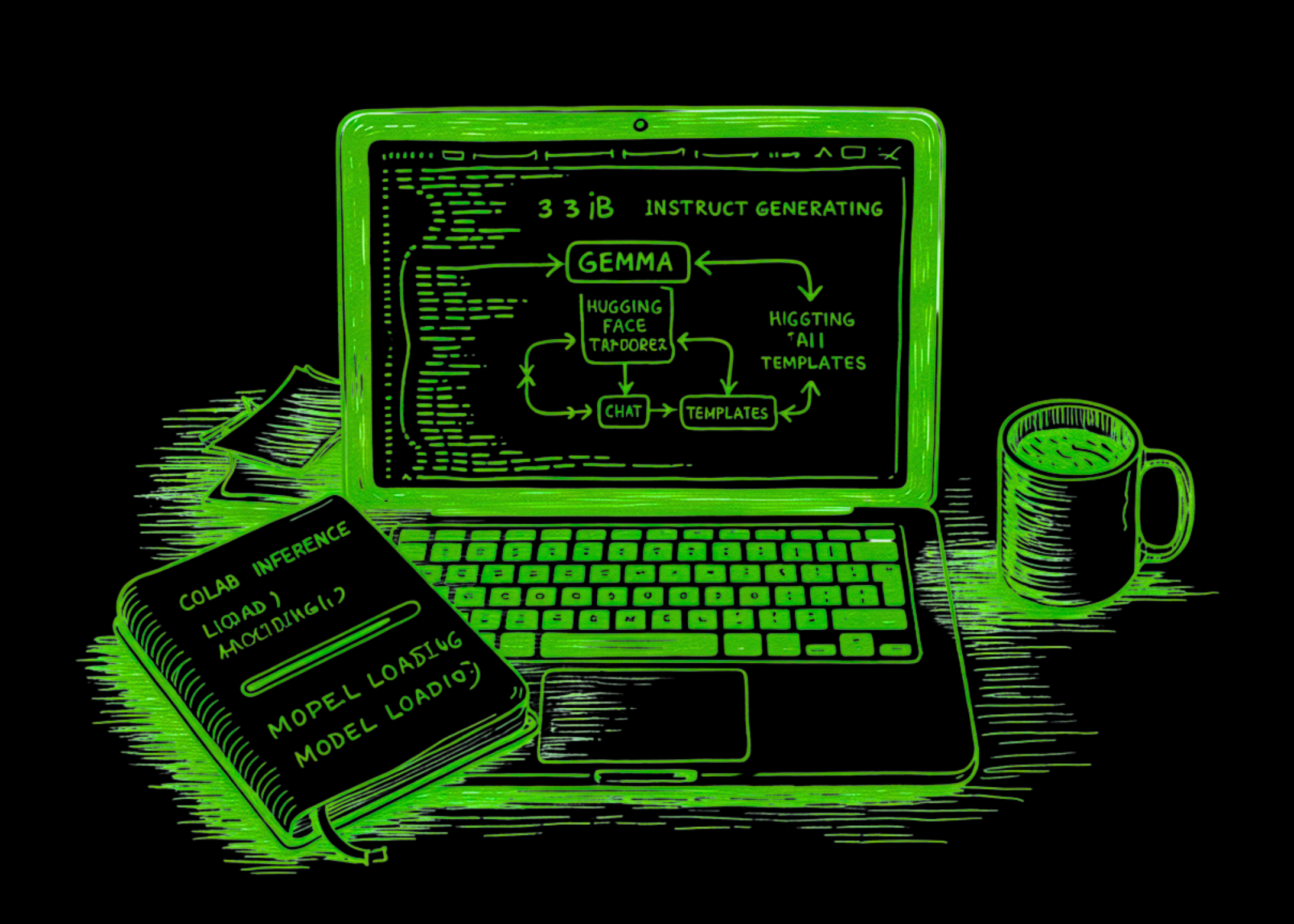

In this tutorial, we build and run a Colab workflow for Gemma 3 1B Instruct using Hugging Face Transformers and HF Token, in a practical, reproducible, and easy-to-follow step-by-step manner. We begin by installing the required libraries, securely authenticating with our Hugging Face token, and loading the tokenizer and model onto the available device with the correct precision settings. From there, we create reusable generation utilities, format prompts in a chat-style structure, and test the model across multiple realistic tasks such as basic generation, structured JSON-style responses, prompt chaining, benchmarking, and deterministic summarization, so we do not just load Gemma but actually work with it in a meaningful way.
import sys
import time
import json
import getpass
import subprocess
import warnings
warnings.filterwarnings(“ignore”)
def pip_install(*pkgs):
subprocess.check_call([sys.executable, “-m”, “pip”, “install”, “-q”, *pkgs])
pip_install(
“transformers>=4.51.0”,
“accelerate”,
“sentencepiece”,
“safetensors”,
“pandas”,
)

import torch
import pandas as pd
from huggingface_hub import login
from transformers import AutoTokenizer, AutoModelForCausalLM
print(“=” * 100)
print(“STEP 1 — Hugging Face authentication”)
print(“=” * 100)
hf_token = None
try:
from google.colab import userdata
try:
hf_token = userdata.get(“HF_TOKEN”)
except Exception:
hf_token = None
except Exception:
pass
if not hf_token:
hf_token = getpass.getpass(“Enter your Hugging Face token: “).strip()
login(token=hf_token)
os.environ[“HF_TOKEN”] = hf_token
print(“HF login successful.”)
We set up the environment needed to run the tutorial smoothly in Google Colab. We install the required libraries, import all the core dependencies, and securely authenticate with Hugging Face using our token. By the end of this part, we will prepare the notebook to access the Gemma model and continue the workflow without manual setup issues.
print(“STEP 2 — Device setup”)
print(“=” * 100)
device = “cuda” if torch.cuda.is_available() else “cpu”
dtype = torch.bfloat16 if torch.cuda.is_available() else torch.float32
print(“device:”, device)
print(“dtype:”, dtype)
model_id = “google/gemma-3-1b-it”
print(“model_id:”, model_id)
print(“=” * 100)
print(“STEP 3 — Load tokenizer and model”)
print(“=” * 100)
tokenizer = AutoTokenizer.from_pretrained(
model_id,
token=hf_token,
)
model = AutoModelForCausalLM.from_pretrained(
model_id,
token=hf_token,
torch_dtype=dtype,
device_map=”auto”,
)
model.eval()
print(“Tokenizer and model loaded successfully.”)
We configure the runtime by detecting whether we are using a GPU or a CPU and selecting the appropriate precision to load the model efficiently. We then define the Gemma 3 1 B Instruct model path and load both the tokenizer and the model from Hugging Face. At this stage, we complete the core model initialization, making the notebook ready to generate text.
messages = [
{“role”: “user”, “content”: user_prompt}
]
try:
text = tokenizer.apply_chat_template(
messages,
tokenize=False,
add_generation_prompt=True
)
except Exception:
text = f”<start_of_turn>user\n{user_prompt}<end_of_turn>\n<start_of_turn>model\n”
return text
def generate_text(prompt, max_new_tokens=256, temperature=0.7, do_sample=True):
chat_text = build_chat_prompt(prompt)
inputs = tokenizer(chat_text, return_tensors=”pt”).to(model.device)
with torch.no_grad():
outputs = model.generate(
**inputs,
max_new_tokens=max_new_tokens,
do_sample=do_sample,
temperature=temperature if do_sample else None,
top_p=0.95 if do_sample else None,
eos_token_id=tokenizer.eos_token_id,
pad_token_id=tokenizer.eos_token_id,
)
generated = outputs[0][inputs[“input_ids”].shape[-1]:]
return tokenizer.decode(generated, skip_special_tokens=True).strip()
print(“=” * 100)
print(“STEP 4 — Basic generation”)
print(“=” * 100)
prompt1 = “””Explain Gemma 3 in plain English.
Then give:
1. one practical use case
2. one limitation
3. one Colab tip
Keep it concise.”””
resp1 = generate_text(prompt1, max_new_tokens=220, temperature=0.7, do_sample=True)
print(resp1)
We build the reusable functions that format prompts into the expected chat structure and handle text generation from the model. We make the inference pipeline modular so we can reuse the same function across different tasks in the notebook. After that, we run a first practical generation example to confirm that the model is working correctly and producing meaningful output.
print(“STEP 5 — Structured output”)
print(“=” * 100)
prompt2 = “””
Compare local open-weight model usage vs API-hosted model usage.
Return JSON with this schema:
{
“local”: {
“pros”: [“”, “”, “”],
“cons”: [“”, “”, “”]
},
“api”: {
“pros”: [“”, “”, “”],
“cons”: [“”, “”, “”]
},
“best_for”: {
“local”: “”,
“api”: “”
}
}
Only output JSON.
“””
resp2 = generate_text(prompt2, max_new_tokens=300, temperature=0.2, do_sample=True)
print(resp2)
print(“=” * 100)
print(“STEP 6 — Prompt chaining”)
print(“=” * 100)
task = “Draft a 5-step checklist for evaluating whether Gemma fits an internal enterprise prototype.”
resp3 = generate_text(task, max_new_tokens=250, temperature=0.6, do_sample=True)
print(resp3)
followup = f”””
Here is an initial checklist:
{resp3}
Now rewrite it for a product manager audience.
“””
resp4 = generate_text(followup, max_new_tokens=250, temperature=0.6, do_sample=True)
print(resp4)
We push the model beyond simple prompting by testing structured output generation and prompt chaining. We ask Gemma to return a response in a defined JSON-like format and then use a follow-up instruction to transform an earlier response for a different audience. This helps us see how the model handles formatting constraints and multi-step refinement in a realistic workflow.
print(“STEP 7 — Mini benchmark”)
print(“=” * 100)
prompts = [
“Explain tokenization in two lines.”,
“Give three use cases for local LLMs.”,
“What is one downside of small local models?”,
“Explain instruction tuning in one paragraph.”
]
rows = []
for p in prompts:
t0 = time.time()
out = generate_text(p, max_new_tokens=140, temperature=0.3, do_sample=True)
dt = time.time() – t0
rows.append({
“prompt”: p,
“latency_sec”: round(dt, 2),
“chars”: len(out),
“preview”: out[:160].replace(“\n”, ” “)
})
df = pd.DataFrame(rows)
print(df)
print(“=” * 100)
print(“STEP 8 — Deterministic summarization”)
print(“=” * 100)
long_text = “””
In practical usage, teams often evaluate
trade-offs among local deployment cost, latency, privacy, controllability, and raw capability.
Smaller models can be easier to deploy, but they may struggle more on complex reasoning or domain-specific tasks.
“””
summary_prompt = f”””
Summarize the following in exactly 4 bullet points:
{long_text}
“””
summary = generate_text(summary_prompt, max_new_tokens=180, do_sample=False)
print(summary)
print(“=” * 100)
print(“STEP 9 — Save outputs”)
print(“=” * 100)
report = {
“model_id”: model_id,
“device”: str(model.device),
“basic_generation”: resp1,
“structured_output”: resp2,
“chain_step_1”: resp3,
“chain_step_2”: resp4,
“summary”: summary,
“benchmark”: rows,
}
with open(“gemma3_1b_text_tutorial_report.json”, “w”, encoding=”utf-8″) as f:
json.dump(report, f, indent=2, ensure_ascii=False)
print(“Saved gemma3_1b_text_tutorial_report.json”)
print(“Tutorial complete.”)
We evaluate the model across a small benchmark of prompts to observe response behavior, latency, and output length in a compact experiment. We then perform a deterministic summarization task to see how the model behaves when randomness is reduced. Finally, we save all the major outputs to a report file, turning the notebook into a reusable experimental setup rather than just a temporary demo.
In conclusion, we have a complete text-generation pipeline that shows how Gemma 3 1B can be used in Colab for practical experimentation and lightweight prototyping. We generated direct responses, compared outputs across different prompting styles, measured simple latency behavior, and saved the results into a report file for later inspection. In doing so, we turned the notebook into more than a one-off demo: we made it a reusable foundation for testing prompts, evaluating outputs, and integrating Gemma into larger workflows with confidence.
Check out the Full Coding Notebook here. Also, feel free to follow us on Twitter and don’t forget to join our 120k+ ML SubReddit and Subscribe to our Newsletter. Wait! are you on telegram? now you can join us on telegram as well.